
Sources for Moon Previous Residents
The backward trail for a Moon Township address has an era problem. Deeds can reach much farther back than a current parcel screen, census schedules appear at intervals, and regional directories must be checked edition by edition for Moon coverage. The table keeps those records in their proper lanes. Start with the source that fits the date and question, then preserve the identifiers that let the next source be tested against it.
| Source | Years It Covers | Where Held | What It Shows |
|---|---|---|---|
| Allegheny deeds and deed-index books | 1789-present for record existence | Division of Real Estate, Land Records | Recorded title chain and legal-description bridge. An online cutoff was not verified. |
| Current Real Estate Portal | Current roll | Allegheny County online property search | Present address, parcel/PIN, map-block-lot, and property gateway, not a historical household roll. |
| Historical assessment cards | Pre-2000 tiers are priced; exact card years vary | Office of Property Assessments copy request | Historic assessment and building context for an exact parcel or year. |
| Historic Pittsburgh directories | 1815-1945 collection; 1837-1930 with gaps in collection notes | Historic Pittsburgh | Possible regional address context only after confirming the volume covers Moon. |
| Carnegie directory microfilm and census | Directory run listed through 1975; census microfilm 1790-1920 | Carnegie Library Pennsylvania Department | Regional directory shelf and census pairing, with volume geography checked first. |
| Federal census and Estates Index | Public census schedules through 1950; Estates Index 1788-1971 | NARA and Carnegie Pennsylvania Room | Household at an enumeration date, or estate and fiduciary leads. |
Mooncrest adds a narrower local source: Community Development may hold Certificate of Appropriateness or related review material for a historic-district property. Those files can date a change to a structure, but they do not replace a deed chain or prove who lived at the address.
Begin Moon Previous Residents With PIN
Use the Allegheny County Real Estate Portal to turn a current address into a stable parcel identity. The public screen searches by Address or Parcel Number. In address mode, enter the base street name without a suffix, add a house number when known, and select Moon Township when a shared street needs narrowing. The public search screen inspected for this research does not offer an owner-name field. Its job is to locate a known parcel, not to produce a name-first list.
Save the PIN or map-block-lot exactly as shown, along with the situs, legal description, and present correspondence lines. A zero, hyphen, or suffix can distinguish one parcel from the next. The County also warns that a property first taxable in 2027 will not appear until values are certified in January 2027. That notice is a current-data timing limit, not proof that a place has no history.
Parcel note. An Allegheny parcel can show a physical location, owner mailing address, and tax mailing address. The latter two are correspondence paths, not proof that a person lives there.
Trace Moon Previous Residents Through Deeds
Recorded land documents provide the backward framework. The County Division of Real Estate holds deeds, mortgages, plans, block-and-lot maps, historical plat maps, and property-history cards. Start with the most recent recorded conveyance tied to the parcel. Note the grantor, grantee, recording date, document number or book and page, municipality, legal description, plan reference, and the prior-deed citation. The prior reference is the next link, not a conclusion by itself.
- Find the subject parcel through its current address and retain its PIN, map-block-lot, and legal description.
- Obtain the most recent recorded conveyance and copy every identifier, including its prior-deed reference.
- Retrieve the cited earlier instrument and compare its legal description, plan, lot, or metes-and-bounds wording to the newer deed.
- Repeat the prior-reference search, treating each earlier seller as a person or entity to be verified by the next document.
- When the web route no longer reaches the needed record, use the Division of Real Estate's historic deed-index books and deed books.
Allegheny County verifies deeds from 1789, but no official cutoff for the present online index was found in the research. Do not supply a guessed cutoff. The County offers in-person, mail, online-copy, and phone channels for land material, and it does not provide legal advice about the meaning of a deed.
Read Moon Records Deed Terms
An old house number can change, disappear, or describe only part of a later parcel. The legal description is the bridge when that happens. It may name a plan book volume and page with a lot number, describe metes and bounds, or cite a prior deed. A subdivision, consolidation, or plan revision can require the research to leave the street number behind and follow the older legal language.
- Grantor
- The person or entity transferring an interest in a recorded instrument.
- Grantee
- The person or entity receiving that recorded interest. A later document must confirm the connection.
- Chain of title
- The sequence of recorded transfers traced through deeds and their prior references for a particular property.
- Legal description
- The formal land description, such as a lot and plan reference or metes and bounds, that connects records when street labels differ.
- Map-block-lot or PIN
- The County parcel identifier carried from the property record into map and land-record research.
The chain describes recorded transactions. It does not by itself establish every person recorded at the address during the same period. Use an address listing or census to test the household layer, and retain the date attached to each record type.
Pair Moon Past Residents With Census
Past residents are best approached as a dated comparison, not a single list. A verified regional directory may place a person at an address for the edition year. A census schedule groups a household at its enumeration date. A deed documents a recorded property transaction. Their dates and purposes differ, which is why a record pair is stronger than repeating one source several times. The latest public federal decennial schedule is 1950 under the 72-year release cycle.
- Choose an address and directory edition whose geographic scope is verified for the historical locality.
- Record the exact printed name, address, edition date, page, and abbreviation-key meaning.
- Check the nearest public census date, using the enumeration record as a dated household snapshot.
- Compare the address with the parcel legal description and recorded deed trail rather than assuming a matching street label is enough.
- Move to the next verified directory or census interval, noting uncertainty when a volume does not cover Moon.
The regional shelves and their coverage limits are detailed on the Moon Township city directories page. A present street search serves a different purpose and belongs with the address-focused directory tools.
Check Moon Records Evidence
A deed establishes a recorded transfer, not a full household. A directory can show a printed address and sometimes an occupation, but the edition may not cover Moon Township. A census can show a household at one official date, while an assessment card can provide property context. Marriage, probate, obituary, and vital material can help explain a name or event, but each has its own access rules. Keeping the source roles distinct is the most reliable way to avoid overstating who lived here before.
Pennsylvania's genealogy access information distinguishes archival historical research from current certified vital-record requests.
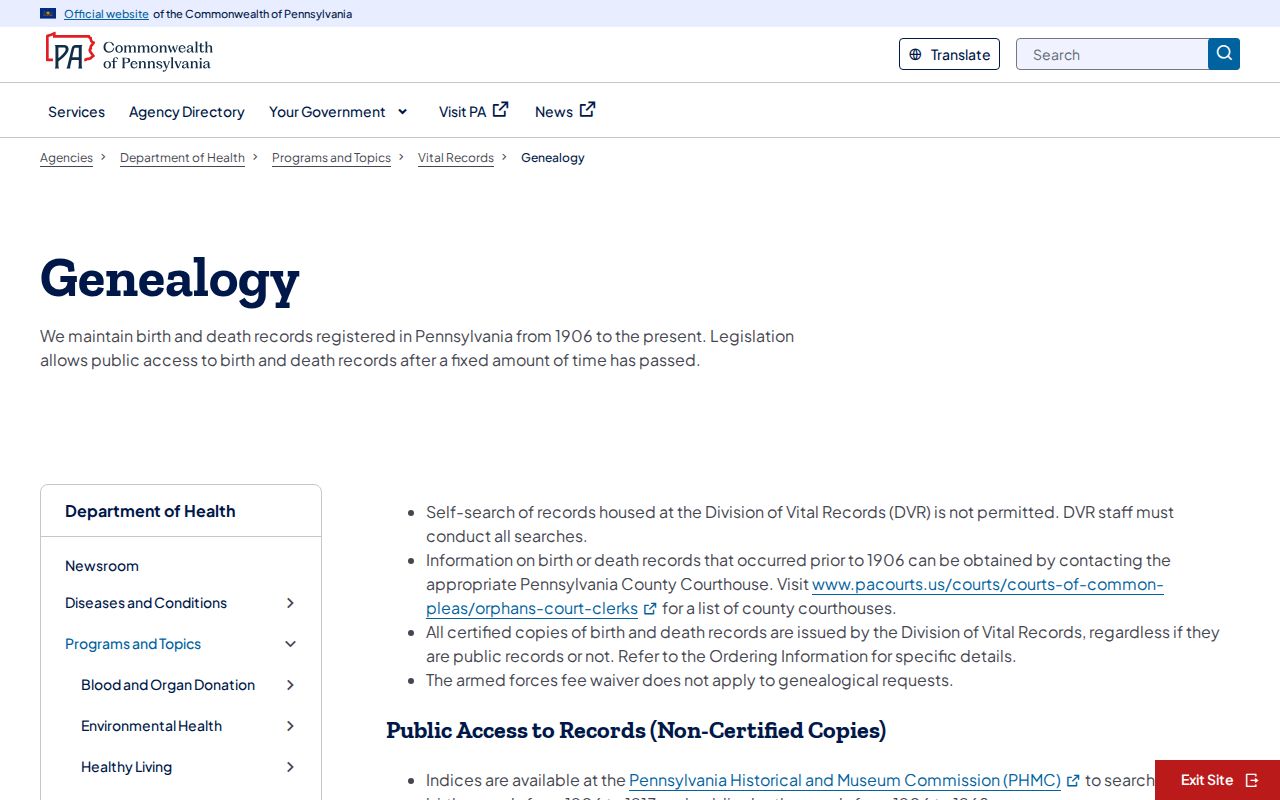
Birth reports become public after 105 years and death records after 50 years. The public non-certified ranges described by the Commonwealth are births 1906-1913 and deaths 1906-1968. A historical vital record can support a life event or relationship question, but it does not turn a mailing line into proof of an address.
Mooncrest Records Context
Mooncrest is a useful local timing marker. The Township says the federal government designed and built the community in 1943 for war-production workers, and Moon declared it a local Historic District in 2005. For a property within the district, a Certificate of Appropriateness can be required before certain additions, alterations, reconstruction, or demolition work. Community Development records may therefore provide an alteration or review trail that sits alongside, rather than inside, the land records.
Moon's historical-preservation work identified 147 resources across 14 neighborhoods. That context helps frame a house-history request, especially when a deed says little about a structure. No public Moon permit or code-case search interface was verified, so ask the Township Open Records Officer or Community Development for a particular address, record type, and time period rather than promising an online result.
Moon Records Estate Trails
When a deed chain points to a death, estate records may supply a case era, fiduciary, or other documented connection. The Allegheny Estates Index covers 1788-1971 at Carnegie's Pennsylvania Room, while the County Wills and Orphans channel handles estates, wills, guardianships, and related court material. Use the actual case file to test a relationship or address. Court records have their own custodian and copy rules, rather than an RTKL workaround.
Allegheny County court-record guidance directs file-copy requests to the appropriate court records office.
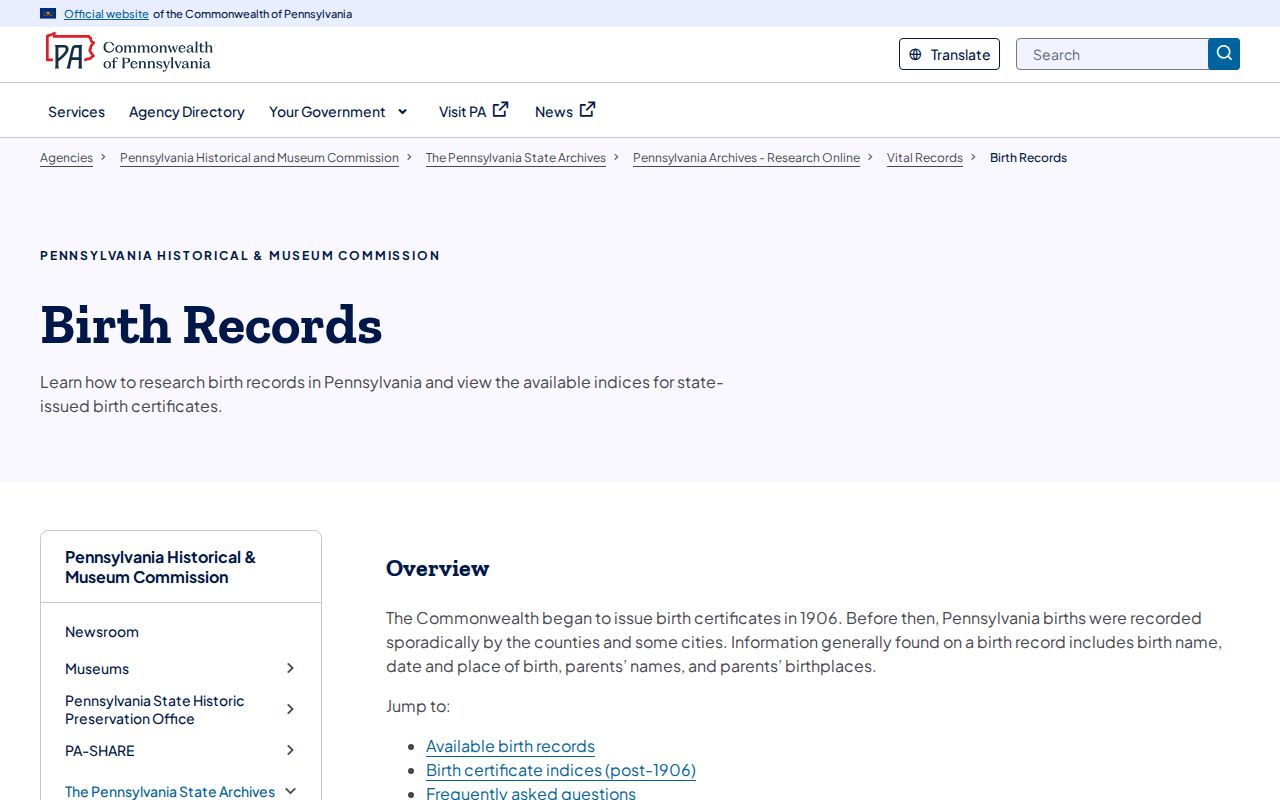
For archival vital research, the State Archives provides non-certified copies while the Department of Health remains the source for certified copies. State Archives material also lists public birth indexes from 1906-1913 and death indexes from 1906-1968. Start with the name, date, and certificate number when available, and use the Archive's reference-order route when staff research is needed.
The Pennsylvania State Archives birth-record page explains its historical index and copy-request route.
Estate and vital material can close a historical question, but neither should be used to fill a gap with assumption. Preserve the custodian, date, and document reference beside the corresponding deed or directory result.
Moon Records Address Labels
The key Moon address problem is records geography, not a verified townshipwide street renumbering. Original Moon Township covered 143 square miles and later produced 55 municipalities. A historical record may therefore appear under Moon's larger historic area, a neighboring municipality, a Coraopolis or Pittsburgh postal designation, a plan and lot, or another predecessor label. Retain the municipality printed by each source rather than replacing it with the modern label.
No authoritative source identifying a Moon street renumbering or renamed-street year was found in this research. Before deciding that an address is absent, compare its legal description, plan book and page, map-block-lot, adjacent municipality labels, and the actual geographic scope of any directory. County Address Management maintains the countywide 911 dataset, while the municipality assigns or corrects local addresses.
Jockers Context for Moon Residents
The Dr. Robert A. Jockers Historical Research Repository is Moon's practical house-history contact when a portal trail ends. The Township Historical Society invites local stories, memorabilia, and historical material, while Moon Township Public Library supplies genealogy and reference contacts plus in-library Ancestry Library Edition. Prepare a concise packet before asking for help: current and older address forms, PIN or map-block-lot, plan or lot references, deed numbers, and years already checked.
The repository is open Tuesday from 1:00 to 4:00 p.m. and Wednesday from 6:00 to 9:00 p.m. It may have photographs, oral history, neighborhood context, school or newspaper leads, or other donated material. Those holdings add context to primary county records, but they should remain clearly labeled as repository material rather than a public index of previous residents.
Lawful use. Moon Township house and family history belongs to careful personal research. Do not use an older address trail to stalk, harass, or target a living person.